Showing posts with label vital. Show all posts

Monday, 26 January 2026

Irish Bread and its Lessons on life

Across cultures and centuries, bread has often been the measure of whether a household is secure, whether a day will be endured, whether a community will hold. In Ireland, we have unique breads not found anywhere else. Not only do they look and taste different, but these breads also have valuable lessons baked in. I shall focus on four favourites of mine: soda bread farls, veda bread, wheaten bread, and potato bread.

Soda bread farls

Soda bread involves no waiting for yeast to rise and requires no oven. You simply use plain flour, baking soda, salt, and buttermilk. The farls are quick to make on a griddle, though getting the mixture just right takes practice. I have watched my mother make soda farls every week of my life for sixty years, yet I still cannot replicate her bread. Now in her nineties, she continues to produce these delicious farls. She cuts the dough into four by rolling a small side plate through it — she’s the only person I know who does this.

lesson learned:

When you don’t even have an oven, you can still make bread. It’s been said that “Appreciation is yeast, lifting the ordinary to the extraordinary,” yet soda bread farls need neither yeast nor oven — and still taste extraordinary.

Veda bread

Veda bread is a traditional malted loaf most strongly associated with Northern Ireland. However, it originated in Scotland, where a baker developed a bread using malted grains (cereal grains soaked in water to encourage germination, then dried with hot air to halt the process) and malt extract. Veda is darker than ordinary bread, naturally sweet without added sugar, and soft and easy to eat.

Allowing grain to sprout sends it a message: “Time to grow.” That message activates enzymes which break down stored compounds, making the grain easier to digest. A seed must be buried — hidden and unseen — so that growth can begin in stillness and darkness. A dry seed is closed and inert. Water softens it; only then can it change. The seed already contains everything it needs, but it must break open to grow.

There are many lessons in this bread:

  • Periods of waiting, obscurity, or difficulty are not wasted. Transformation often begins before anything visible happens.

  • Growth requires openness. Rigidity protects, but it also prevents transformation. Softening demands humility, love, and hope to trigger inner change.

  • True purpose unfolds through self-sacrifice, not self-preservation.

Wheaten bread


My mother makes soda bread farls in our home, but I am the wheaten bread maker. It helps that wheaten bread is quick and easy to prepare. Because it uses whole wheat, it retains the entire grain kernel — the fibre-rich bran, nutrient-dense germ, and starchy endosperm. As a result, it provides significantly more fibre, vitamins, minerals, and antioxidants. Refined white flour has most of these removed, resulting in lower nutritional value and faster blood sugar spikes.

Instead of yeast, wheaten bread uses baking soda for lift, so it comes together quickly and has a tender, slightly crumbly texture. But without the oven, the dough remains unfinished.

Lessons learned:

Sometimes, taking things out of wheat reduces the benefits the bread brings. In life, keep it simple — don’t overcomplicate. Often, rewards come not from what you take out of life, but from what you leave in.

Trials refine us. Heat does not destroy the bread; it fulfils its purpose. Wholeness comes through unity, transformation, and service, and spirituality is expressed in small, daily, faithful acts.

Potato bread

Potato bread speaks of ingenuity in times of scarcity. Very few cultures make bread from potatoes, but some do so out of necessity when grain is scarce. The Irish are among the few who eat potato bread as a staple. Imagine, then, the absolute disaster of the potato blight.

This disease (Phytophthora infestans) arrived in Ireland in 1845, causing potatoes to rot both in the ground and in storage. At the time, the population — 8.5 million in 1841 — depended almost entirely on potatoes for food. The repeated crop failures, which came and went for seven years, were catastrophic. Around one million people died from starvation and disease, and another one to two million emigrated. Ireland’s population fell by roughly 25%, a loss from which it has never fully recovered, almost 200 years later.

Sadly, this experience is not uniquely horrific. History offers many other examples.

Lessons learned

When you don’t have wheat to make bread, take what you do have and make bread. If even that is taken from you, flee before you die.
When huge numbers of people flee their country, always ask why — and show the compassion you would hope to receive in their situation.

Monday, 31 January 2022

A practical call to action for all

In the last decades many have shown a considerable capacity to learn and to grow.  Hand in hand with that personal development service and love for others has also grown.  Despite all this progress, the coming challenging decades will require abilities seemingly impossible from today’s perspective.  Given this, it is vital that we now seek urgently to fortify both ourselves and the communities we live in.

Often, we find ourselves missing something necessary for our growth, tranquillity and spiritual development. That ideal ingredient for any individual, community or institution is the understanding and belief that all are part of world-wide community.  Only when this concept is accepted can real progress, peace and the serious problems facing humanity begin to be solved.

In any endeavour whether material or spiritual a vision is required, an overriding clarity about the objectives to be achieved. It helps to have this in our minds at all times. Our purpose in life is clear, to work for the betterment of the world and to help humanity to live in concord and harmony.  To achieve this, we will require more than our own endeavours it will also require a vibrant, outward-looking community working alongside us.  The journey to our goal will have to entail both spiritual and material progress.  In order to build momentum, meaningful conversations with those around us are necessary and will help shape that very development. However, if the betterment of the world is to be achieved still more is needed. In order to trigger a society-building power, energies latent, but so far largely unexpressed, in humanity will have to be awakened.  It is worth focussing on some vital much-needed qualities.

Qualities of cooperation and mutual assistance will have to be developed to ensure human society advances in both progress and prosperity.  Sufficient moral vigour and spiritual health will prove basic necessities for individuals and communities everywhere.

The betterment of this world will be dependent on other basic qualities, singularly lacking in today’s society, such as unity, trustworthiness, mutual support, collaboration, fellow feeling, selflessness, commitment to truth, a sense of responsibility, a thirst to learn and most importantly love.  This is not an intellectual exercise in self-advancement it is a practical call to action for all.  Make no mistake, the degree to which we respond to the pressing needs of the age in which we live will determine all our futures and indeed those of future generations.

"The civilization of today, for all its material prowess, has been found wanting.."

The Universal House of Justice 

Thursday, 17 September 2015

Why are the Wealthy buying all the Water?

Sometimes the immediate problem is so overwhelming that it does not allow a broader perspective. Scenes of thousands or tens of thousands of refugees fleeing to Europe has tested the heart and integrity of many institutions. Since so many European leaders were elected to reduce newcomers to their borders, there was a major landslide of right wing groups to positions of power. Contrast that, with the overwhelming humanitarian response engendered in so many European citizens at the obvious helplessness of refugees fleeing war.  That photograph of a tiny drowned three year old on a beach in Turkey hit home. 

The media shows its ingrained amoral approach with headlines screaming, “Build a bigger wall to keep the hoards out!” or “Our Culture under threat!” The next day they proclaim self righteously, “How many more must die getting to Europe?”  Our frenetic bipolar media is driven by circulation figures and set their moral compass by the prevailing wind direction. It seems our politicians, institutions or media are not to be trusted. So perhaps a clearer perspective can be gained by examining not what they are saying but what they are doing? 

George Bush (net worth $20 million) is busy buying huge qualities of land, 300,000 acres in the sparsely populated wastes of Paraguay, in South America. His land, though not impressive in appearance, rests atop one of the largest freshwater aquifers in the world: Acuifero Guarani.

Acuifero Guarani covers roughly 460,000 square miles under parts of Brazil, Paraguay, Uruguay and Argentina and is estimated to contain about 8,900 cubic miles of water.  Other major companies are following his path, as water has been identified as a critical commodity. Wall Street banks and multibillionaires are acquiring water assets as fast as they possibly can. Philippine’s Manuel V. Pangilinan (net worth $508 million), Hong Kong’s Li Ka-shing (net worth $26.6 billion) and T. Boone Pickens (net worth US$1.2 billion) are racing to get their hands on this newest commodity, more precious and vital than oil.  Legal structures are already strengthening their strangle hold on water rights. Gary Harrington’s case in Oregon is an example. He tried to use rain water collected in  three ponds on his own land ended up in prison for 30 days. Contrast this with Boone Pickens draining 65,000,000 gallons of water a year from the Ogallala Aquifer.  Note: Once depleted, the aquifer will take over 6,000 years to replenish naturally through rainfall

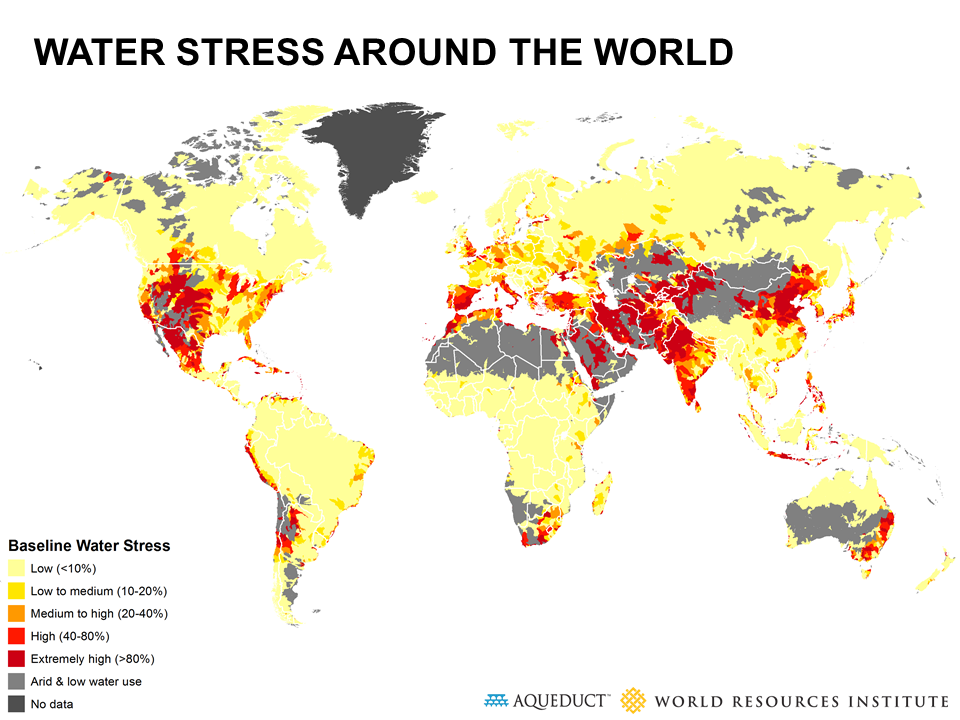
Those of you experiencing an endless downpour (as in N. Ireland!), are probably asking what is so special about water? Well, like most things such as mobility, health and security  it is not until you lose something that you begin to appreciate how important it is. In the case of water, man-made climate change has altered our world. To get a broader perspective we have to look at our world and understand where droughts have been happening.


East Africa has suffered from the worst drought in 60 years.  Somalia. Dibouti, Ethiopia and Kenya are suffering and the resulting disastrous harvests mean starvation is not far behind these droughts.  In Afghanistan, as a result of droughts, 60-80% of their livestock has died.  In India 130 million people have been affected by water shortages.  Iran has just had their worst drought in a hundred years.  Morocco’s worst drought in a decade has affected 70% of its arable land.  Three million people in Pakistan face starvation due to drought devastated crops.  Brazil has faced its worst drought in 80 years and São Paulo with a population11.8 million (a megacity) is dealing with a nasty water crisis.   South Africa has had their worst drought since 1992 (twenty three years ago).  Syria, from 2006 to 2011 suffered their worst drought and crop failure in recorded history.  Is the picture becoming clear?  Climate change is happening and the resulting water shortages with crop failures are destabilising, creating wars and millions of refugees.


How does the world respond?  Will nationalism, xenophobia and chaos do anything other than empower the really rich and really powerful to proceed with an agenda that beggars belief.  The gap between rich and poor has never been greater.  “Billionaires and politicians gathering in Switzerland this week will come under pressure to tackle rising inequality after a study found that – on current trends – by next year, 1% of the world’s population will own more wealth than the other 99%.” Don’t expect those without water, food or security to stay and die at home quietly.  They cannot be the price the rich are willing to pay for their bottom line.  Ask yourself, if it was your family what would you do?  Would staying put even be an option?

By not standing back to see the broader picture we can waste so many valuable resources.  When Southern and Central Somalia’s acute malnutrition rose from 16.4% to 36.4% in 2011 the world was having to spend three million dollars over five months to truck in water.  Spending only 900,000 dollars to mitigate the drought and build up water resources beforehand would have saved money and more lives.


We have an obligation to ask the larger questions.  Why, when the earth is facing global challenges  that are frankly more scary than anyone wants to admit (climate predictions) are we allowing the flames of nationalism and economic greed prevent us from finding a sensible and sustainable way forward. When people get annoyed at an influx of refugees from Syria, Afghanistan or Somalia at least let us be armed with the facts behind their heartache and suffering.


1. http://www.globalresearch.ca/the-new-water-barons-wall-street-mega-banks-are-buying-up-the-worlds-water/5383274
2.  http://www.scientificamerican.com/article/corporations-grabbing-land-and-water-overseas/
3.  http://www.citymetric.com/horizons/drought-megacity-sao-paulo-withering-after-dry-wet-season-1244
4. http://agorafinancial.com/2015/04/24/why-did-george-bush-buy-nearly-300000-acres-in-paraguay/
5.  http://www.wri.org/blog/2015/06/global-tour-7-recent-droughts